
The Best Fluffy Pancakes recipe you will fall in love with. Full of tips and tricks to help you make the best pancakes.
Rainwater Storage Calculator
Calculate your roof's rainwater harvesting potential, determine the ideal storage tank size, and estimate your water independence for gardening or off-grid living.
Catchment Parameters
Harvest Potential
Total Annual Harvest
0
gallons / year
Caution: Your annual harvest is less than half of your required demand. Consider expanding catchment area or reducing usage.
Recommended Tank Size (90 Days Supply)
0
gallons
Annual Demand Coverage
0%
of needs met
Was this tool helpful to you?
Thank you for your feedback!
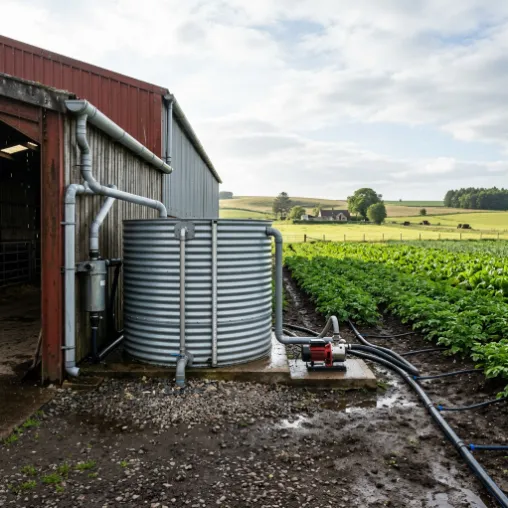
Why Harvest Rainwater?
Securing an independent water supply is incredibly empowering, whether you're tending a backyard garden, watering livestock, or building an off-grid homestead. Municipal water can be expensive and is often treated with chemicals like chlorine, which aren't ideal for soil microbes and sensitive plants.
By calculating your roof's actual yield potential, you avoid the common mistake of buying storage tanks that are either too small to be useful during a drought, or too massive to ever actually fill up. Designing a balanced system ensures you maximize your budget and your water resilience.
How It Works
Designing your rainwater catchment system requires three key steps.
1
Measure Catchment
Calculate the total horizontal footprint of your roof (length x width). Roof pitch doesn't change the amount of rain that falls on that area.
2
Check Rainfall Data
Look up the historical annual rainfall for your specific zip code to establish a realistic baseline for yearly collection.
3
Size Your Tank
We recommend sizing a tank that holds at least a 3-month (90 days) buffer of your daily water demand to survive dry spells safely.
Water Usage Benchmarks
General estimates to help you determine your daily water demand.
| Activity / Need | Category | Estimated Usage |
|---|---|---|
| Vegetable Garden | Irrigation | ~62 gallons / 1,000 sq ft / day |
| Large Livestock (Cow/Horse) | Agriculture | 10 - 15 gallons / animal / day |
| Small Livestock (Sheep/Goat) | Agriculture | 1 - 2 gallons / animal / day |
| Indoor Domestic Use | Homesteading | 50 - 80 gallons / person / day |
| Standard Toilet Flush | Household | 1.6 gallons / flush |
Formula Used for Calculation
The universal formula for rainwater catchment relies on the constant that 1 inch of rain on 1 square foot yields 0.623 gallons.
Area (sq ft)
×
Rainfall (in)
×
0.623
×
Efficiency
=
Harvest (Gallons)
Trusted by Homesteaders & Growers
See how correctly sizing water systems saves money and headaches.
"Perfect for sizing the cistern for my off-grid cabin. I realized a 1,000-gallon tank wasn't enough to get through our dry summers, so I upgraded to 2,500 before installing."
JD
James D.
Off-Grid Homesteader
"Used this to plan the rainwater catchment for our high tunnels. The 0.623 conversion factor always confused me before, but this lays it out so simply."
SL
Sarah L.
Market Gardener
"Great visual tool. Helped me explain to my HOA board exactly why we needed a 500-gallon tank instead of the tiny 50-gallon barrels they were originally suggesting."
MT
Mark T.
Urban Gardener
"Spot on calculations. We capture water off our large barn roof for the livestock, and this helped us budget for the exact culvert cistern size we required."
ER
Emily R.
Rancher
"I love the '90 days of supply' feature. When doing consultations, it makes planning for the dry season much easier to visualize for my clients."
DK
David K.
Permaculture Designer
"Saved me from buying an oversized, expensive tank. The math proved my small garage roof footprint wouldn't even come close to filling a 5,000-gallon tank in a year."
TW
Tom W.
Homeowner
Frequently Asked Questions
No. You only need to measure the horizontal footprint of your roof (length x width of the building, plus overhangs). While a steeper roof will shed water faster, the actual volume of rain falling from the sky onto that specific footprint remains the same.
A 100% collection efficiency is impossible in real life. You lose water to evaporation, splashing out of gutters, overflowing during massive downpours, and "first flush" diverters (which discard the first few gallons of dirty water off the roof). 85% is a safe, realistic estimate for metal roofs, while shingle roofs might be closer to 75%.
Not straight from the tank. Rainwater can pick up bird droppings, dust, and roofing materials. For potable (drinking) use, it must be properly filtered (usually with carbon block filters) and purified (using UV light or chlorine). It is, however, excellent for watering plants and livestock without heavy treatment.
Rain doesn't fall evenly throughout the year. Many regions experience 2 to 3-month dry spells during the summer when water demand is highest. Having 90 days of storage ensures you have enough buffered supply to get through a long drought without your tank running dry.
Metal roofing (galvanized steel, standing seam) is considered the gold standard. It is smooth, has a high collection efficiency, and doesn't shed toxic particles. Asphalt shingles shed grit and petroleum compounds, making them fine for ornamental gardens but less ideal for food crops or drinking.
Laws vary drastically by location. In many states and countries, it is highly encouraged and even subsidized. However, in some Western US states (like Colorado), there are strict limitations on how much you can collect due to historical water rights. Always check your local regulations before installing large tanks.
Related Management Tools
Explore our other calculators for homesteaders and farmers.
Fertilizer Blend Calculator
Calculate the exact blend of nutrients needed for your crops based on soil test results.
Seed Rate Calculator
Determine the optimal amount of seed required for your field area to maximize yield.
Water Storage Calculator
Calculate the required storage capacity for your farm based on daily irrigation needs.
Need a Custom Calculator?
Don't see the specific environmental or homesteading management tool you need? We can build it tailored to your exact requirements.
Contact Us