
The Best Fluffy Pancakes recipe you will fall in love with. Full of tips and tricks to help you make the best pancakes.
Mulch Cost Calculator
Accurately predict how much mulch you need for your garden beds before you head to the store. Factor in dimensions and desired depth to get instant material and cost estimates.
Enter Bed Dimensions
Projected Requirements
Estimated Total Cost
$112.50
Total Bags Needed
25
bags
Total Volume in Bulk
1.85
cubic yards
Was this tool helpful to you?
Thank you for your feedback!
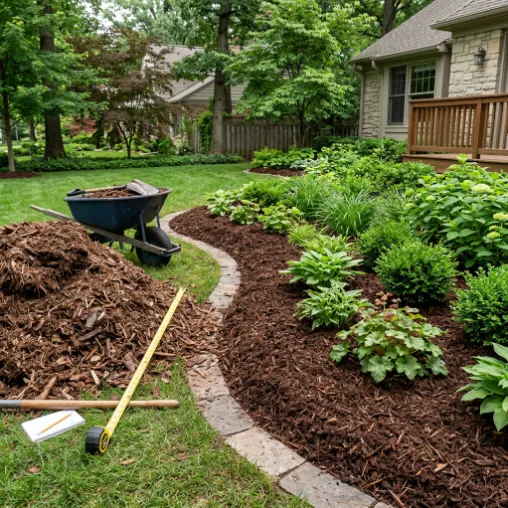
Why Calculate Mulch?
Mulch is an essential material applied to the surface of soil. It is primarily used to conserve moisture, improve the fertility and health of the soil, reduce weed growth, and enhance the visual appeal of the area.
Knowing exactly how much mulch to buy is crucial. Buying too little means an extra trip to the home improvement store, while buying too much wastes money and effort. By converting your garden's square footage into precise cubic volumes, you can decide whether it's more cost-effective to buy individual bags or order a bulk delivery in cubic yards.
How Our Calculator Works
We process your dimensions using standard landscaping formulas to give you accurate material projections.
1
Measure the Area
Enter the length and width of your garden bed, and decide how deep you want the mulch layer to be (usually 2-4 inches).
2
Define Materials
Provide the volume of the bags you plan to buy (standard is 2 cubic feet) and the price per bag.
3
Instant Projection
Our tool calculates the total cubic volume required, giving you the exact bag count and overall estimated cost.
Standard Mulch Coverage
Use this quick reference to see how much area common volumes cover.
| Volume | At 2" Depth Covers | At 3" Depth Covers |
|---|---|---|
| 1 Bag (2 cu. ft.) | 12 sq. ft. | 8 sq. ft. |
| 1 Bag (3 cu. ft.) | 18 sq. ft. | 12 sq. ft. |
| 1/2 Cubic Yard | 81 sq. ft. | 54 sq. ft. |
| 1 Full Cubic Yard | 162 sq. ft. | 108 sq. ft. |
Formula Used for Calculation
This calculator uses standard volume geometry to find cubic feet, then divides by the bag size to estimate totals.
Square Footage
×
Depth (in feet)
÷
Bag Volume
=
Bags Needed
Trusted by Landscapers & Gardeners
See how this mulch estimation tool helps property owners worldwide.
"This estimator is very close. We used it right before spring landscaping and the number of bags perfectly covered our beds. Would love a save feature."
LS
Liam Smith
Landscape Contractor
"Very clean interface and works perfectly on my phone. The instant conversion is great, though I wish it supported circular area calculations for tree rings."
OJ
Olivia Johnson
Homeowner
"The standard coverage table is a great quick reference. It handles all the math instantly. An absolute essential tool for weekend garden warriors."
NW
Noah Williams
Property Manager
"Loads fast and has no annoying ads. We plugged in our dimensions and it gave us a highly accurate read on our material cost. Very satisfied with this tool."
EB
Emma Brown
Garden Designer
"It's decent for basic rectangular beds. As a professional, I often need to calculate complex curves, so I have to do some manual math before plugging numbers in here."
OG
Oliver Garcia
Turf & Soil Specialist
"Simplifies the volume math beautifully. It's incredibly helpful to quickly play with the depth variable to see how much money we could save by going thinner."
AM
Ava Martinez
Community Garden Head

Frequently Asked Questions
A Mulch Calculator is an online tool that helps you estimate the total volume of mulch (in bags or cubic yards) required to cover a specific area of your garden.
For most garden beds, a depth of 2 to 3 inches is recommended. This is deep enough to suppress weeds and retain moisture, but not so deep that it suffocates plant roots.
One cubic yard is equal to 13.5 bags (of 2 cu. ft. each). If your project requires more than 2 or 3 cubic yards, having bulk mulch delivered is usually much cheaper and requires less plastic waste.
Yes! The volume math is exactly the same for topsoil, compost, and gravel. Just ensure you know the bag size or are checking the cubic yards output.
Organic mulch (like wood chips or bark) typically breaks down and needs to be replenished or fully replaced every 1 to 2 years to maintain its benefits and appearance.
Eyeballing landscaping materials almost always leads to overbuying (wasting money) or underbuying (causing frustrating extra trips to the store). Math solves this problem instantly.
Related Landscaping Tools
Enhance your property management with these calculators.
Fertilizer Blend Calculator
Calculate the perfect N-P-K blend and custom fertilizer mixes for your soil needs.
Seed Rate Calculator
Calculate exact planting density and bags of seed required for the spring planting season.
Water Storage Calculator
Estimate water storage capacity for tanks, reservoirs, and agricultural ponds.
Need a Custom Calculator?
Don't see the specific landscaping or gardening tool you need? We can build it tailored to your exact requirements.
Contact Us