The Best Fluffy Pancakes recipe you will fall in love with. Full of tips and tricks to help you make the best pancakes.
Livestock Feed Calculator
Accurately budget ration expenses and plan inventory. Estimate total feed requirements, total bags or tonnage, and daily cost per head for cattle, sheep, horses, goats, and poultry.
Herd & Ration Details
Feed Budget Estimate
Total Estimated Feed Cost
$
5,940.00
Total investment to purchase whole bags/bales needed.
Units to Purchase
360
Whole Bags / Bales Needed
Total Feed Mass
18,000
lbs
9.0 tons
Cost / Head / Day
$
7.92
Average daily cost
Was this tool helpful to you?
Thank you for your feedback!
Why Accurate Feed Budgeting Matters
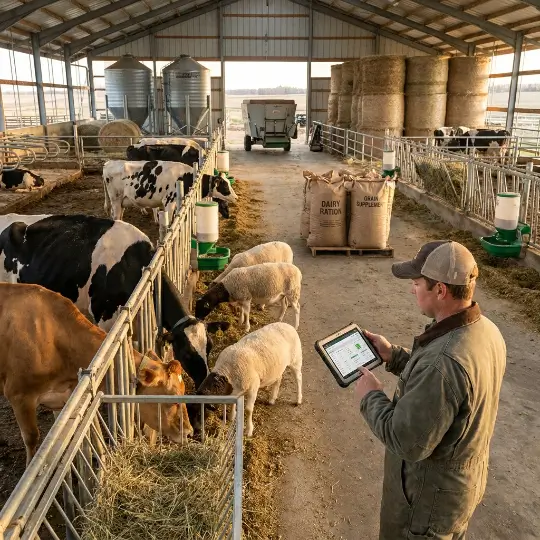
Feed represents 55% to 75% of total production costs for livestock operations. Inaccurate feed estimates can lead to emergency purchases during market spikes, feed shortages during severe winter conditions, or spoilage of excess stored forage and grain.
By calculating precise daily consumption requirements across your herd, flock, or stable, you can lock in favorable bulk supplier discounts, maintain steady animal nutritional balance, and monitor daily cost-per-head margins to ensure livestock profitability.
How It Works
Forecast your herd's nutritional requirements and expenses in three straightforward steps.
1
Enter Herd & Intake
Input your total animal count and the average daily ration intake in pounds based on body weight and life stage.
2
Set Duration & Units
Select how many days you need to feed the group, and enter the weight of a standard bag, bale, or delivery unit.
3
View Full Budget
We compute total bulk tonnage, round up to whole bags to prevent shortages, and generate daily per-head figures.
Average Daily Feed Intake by Livestock Species
Daily dry matter intake generally ranges from 1.5% to 3.5% of mature body weight depending on production status and species.
| Livestock Class | Typical Daily Intake | Nutritional Notes |
|---|---|---|
| Beef Cattle (1,200 lb cow) | 24 - 30 lbs / day | Primarily pasture forage and dry grass/legume hay (approx. 2.0% - 2.5% body weight). |
| Dairy Cattle (Lactating) | 40 - 55 lbs / day | High-energy total mixed rations (TMR) combining silage, alfalfa, and concentrated grains. |
| Horses (1,000 lb mature) | 18 - 25 lbs / day | Quality grass hay baseline (1.5% - 2.0% BW) supplemented with concentrated grain if worked. |
| Sheep & Goats (150 lb ewe/doe) | 3.5 - 5.0 lbs / day | Dry matter forage requirement; increases significantly during late gestation and lactation. |
| Poultry (Layer Flock, 100 hens) | 25 - 28 lbs / day | Averages 0.25 to 0.28 lbs of layer mash or crumbles per bird per day with adequate calcium. |
Formula Used in Livestock Feed Cost
Total ration weight is calculated across the full herd duration, rounded up to whole purchased units, and multiplied by the unit price.
Total Feed (lbs)
(Head × Daily Intake × Days)
(Head × Daily Intake × Days)
÷
Bag Weight
(lbs per unit)
(lbs per unit)
×
Unit Cost
($ per bag)
($ per bag)
=
Total Budget
Trusted by Ranchers & Homesteaders
Helping livestock managers forecast ration needs and protect their operating bottom line.
"Invaluable for calculating our winter hay reserves for 45 cow-calf pairs. The breakdown into total tonnage made booking semi-load deliveries stress-free."
TC
Thomas Clark
"I manage a boarding stable with 18 horses. Having the daily cost per head metric lets me accurately price boarding fees based on real grain market prices."
KB
Karen Bennett
"We run 120 commercial meat goats. This tool helped us budget our supplemental pellet feed leading up to kidding season without overbuying expensive sacks."
GR
Gary Ramirez
"Super straightforward for our poultry operation. We plugged in 300 layer hens and immediately knew how many 50 lb sacks of layer feed we needed for the quarter."
HN
Hannah Nelson
"Great tool for smallholders. Entering bale prices instead of bags gave me an instant read on our sheep flock's total feed outlay over 90 days."
MS
Marcus Sterling
"Simple math, but having it instantly calculate while standing at the feed mill checkout keeps my spreadsheet habits quick and pain-free on my phone."
EW
Evan Walker
Frequently Asked Questions
Most ruminants (cattle, sheep, goats) consume between 2.0% and 3.0% of their body weight in dry matter daily. For example, a 1,200 lb beef cow consumes approximately 24 to 30 lbs of dry forage daily. For lactating dairy cows or growing feeder calves, this intake can rise up to 3.5% - 4.0% of body weight.
Feed retailers and hay suppliers only sell complete units. If your livestock math requires 24.3 bags or round bales, purchasing 24 units would leave your animals short on calories before the feeding period concludes. Rounding up ensures your operational budget reflects actual checkout totals.
Yes. Simply enter your bale weight into the "Bag / Bale Weight" field (e.g., 60 lbs for small square bales or 800-1,200 lbs for large round bales) and enter the price per bale in the cost field. The total requirement and budget will adjust accurately.
Feeding losses commonly range between 5% and 25%. Ring feeders for round bales typically produce 10-15% waste, while unrolled round bales without feeders can see 20-30% loss from trampling. Increase your "Daily Feed per Animal" input by 10% to 15% to buffer against standard feeding waste.
"Dry Matter" (DM) is the nutrient portion of feed after all water has been removed, whereas "As-Fed" represents the actual weight of the ration including moisture. Dry grains and cured hay typically have 85-90% DM, while pasture grass or corn silage can have 50-70% water content. Always input As-Fed weights for commercial purchase budgeting.
Related Agronomy Tools
Optimize your field applications and farm economics.
Fertilizer Blend Calculator
Calculate exact pounds and percentages of Nitrogen, Phosphorus, and Potassium in custom mixes.
Mulch Cost Calculator
Estimate required mulch volume in cubic yards or bags and calculate your total project cost.
Farm Profit Calculator
Project agricultural crop revenue, variable input costs, and net farm operating margins.
Need a Custom Calculator?
Don't see the specific agronomy or landscaping tool you need? We can build it tailored to your exact requirements.
Contact Us