
The Best Fluffy Pancakes recipe you will fall in love with. Full of tips and tricks to help you make the best pancakes.
Garden Soil Calculator
Determine exactly how much topsoil, potting mix, or garden soil you need to fill your raised beds, planters, or garden plots.
Bed Details
Required Materials
Bulk Volume Needed
1.0
cubic yards
Total Cubic Feet
26.7
cu ft
Bag Estimate
18
bags required
Was this tool helpful to you?
Thank you for your feedback!
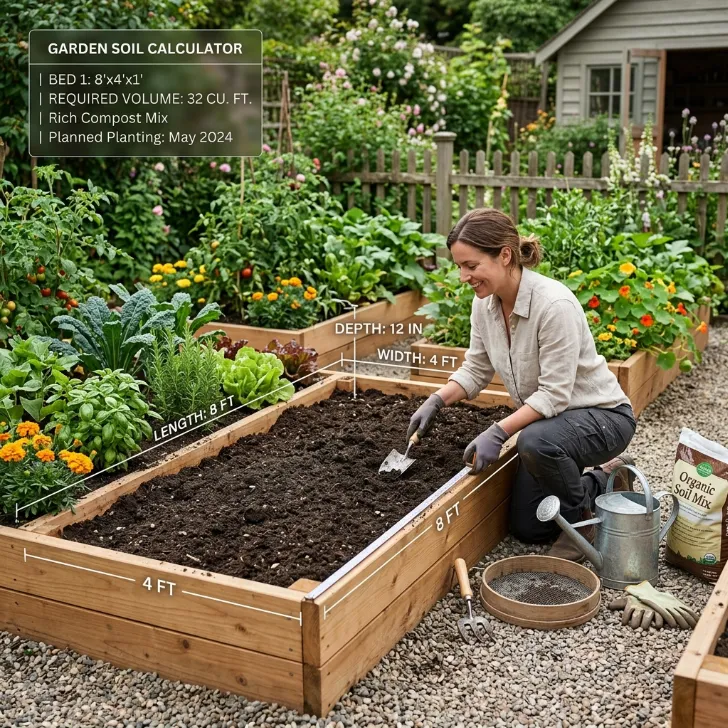
Why Calculate Your Garden Soil?
Building a thriving garden starts with the right foundation. Whether you are filling brand-new raised beds, topping off existing planters, or leveling a spot for a new lawn, getting the exact soil volume right is critical.
Guessing the volume usually leads to two outcomes: expensive, frustrating mid-project trips to the hardware store for more bags, or paying a delivery fee for a giant pile of bulk topsoil that you have nowhere to put. By entering your bed dimensions and desired depth, you can confidently order the exact amount of cubic yards or bags to get the job done right.
How It Works
Calculate your exact soil needs in three simple steps.
1
Measure Dimensions
Choose your bed shape, then measure the length and width (or diameter) in feet using a tape measure.
2
Set the Depth
Determine how deep the soil needs to be in inches. Leave an inch or two from the top rim for watering space.
3
Calculate Volume
We calculate the geometry to give you the exact cubic yards for delivery, and the exact bag count for retail trips.
Common Garden Soil Depths
Not sure how deep your soil should be? Use these standard gardening recommendations as a starting point for your calculation.
| Project Type | Standard Depth | Description |
|---|---|---|
| Topdressing Lawns/Beds | 1 - 2 inches | Adding a thin layer of compost or topsoil to rejuvenate existing beds or lawns. |
| Shallow Planter Boxes | 6 - 8 inches | Sufficient depth for shallow-rooted herbs, lettuces, and small annual flowers. |
| Standard Raised Beds | 10 - 12 inches | The most common depth for growing vegetables like tomatoes, peppers, and beans. |
| Deep Root Crops | 18 - 24 inches | Required for long root vegetables (carrots, daikon) or larger perennial shrubs. |
The Math Behind the Volume
We convert your requested depth from inches into feet, multiply by the area dimensions to find total cubic feet, and divide by 27 to find standard cubic yards.
Area
(Sq Ft)
(Sq Ft)
×
(Depth ÷ 12)
(Feet)
(Feet)
÷
27
(Cu Ft/Yard)
(Cu Ft/Yard)
=
Cubic Yards
Trusted by Gardeners & Landscapers
Helping ensure accurate soil orders for every project type.
"Built three 8x4 raised beds and had no idea how much soil to buy. This tool showed me I needed just over 3 cubic yards total. Delivery was exactly what I needed with zero waste."
JS
John Smith
"Super helpful for converting to standard bag sizes. I was at the home improvement store trying to guess how many 1.5 cu ft bags I needed for my balcony pots. Saved me a second trip!"
ED
Emily Davis
"I constantly under-order compost. Being able to quickly toggle between rectangular beds and circular tree rings makes this the best soil calculator I've used online."
MB
Michael Brown
"Perfect for landscaping estimates. I can show clients exactly why we need 10 yards of topsoil to grade their new lawn area at 2 inches deep. Highly recommend."
SJ
Sarah Johnson
"I love how it automatically calculates the bag count alongside the cubic yards. It made deciding between ordering bulk delivery vs picking up bags myself very easy."
WT
William Taylor
"Straightforward, no fluff, and works great on my phone. The math is always spot on for my seasonal garden prep. Thank you for building this!"
JM
Jessica Martinez
Frequently Asked Questions
Topsoil is heavy, natural earth sourced from the top layer of ground, best used for filling deep areas or lawn grading. Potting soil (or potting mix) is a lighter, soilless blend of peat moss, perlite, and pine bark designed to drain well and prevent compaction in pots and raised beds.
A general rule of thumb is that if your project requires more than 1 cubic yard (which equals roughly 14-18 large bags), ordering bulk delivery from a local landscape yard will be much cheaper and create far less plastic waste. For small planters, bags are more convenient.
Yes! Newly fluffed soil, especially potting mix and compost, will settle by roughly 10% to 20% after the first few heavy waterings or rainfalls. It's often a good idea to add an extra inch of depth to your calculation to account for this natural settling.
Not necessarily. If your bed is taller than 12-18 inches, you can use the "Hugelkultur" method. Fill the bottom half with organic materials like logs, branches, and leaves. Then, calculate and fill only the top 10-12 inches with high-quality garden soil to save money.
A cubic yard is a block of material that measures 3 feet long by 3 feet wide by 3 feet deep. It contains exactly 27 cubic feet. A standard pickup truck bed can usually hold between 1.5 to 2 cubic yards of soil before exceeding weight limits.
Related Garden Tools
Enhance your farm and garden management with these calculators.
Raised Garden Bed Calculator
A specialized tool focusing strictly on lumber dimensions and soil fill for classic raised beds.
Soil Amendment Calculator
Determine exactly how much compost, manure, or biochar you need to topdress your fields.
Mulch Cost Calculator
Estimate the volume of mulch needed and compare the cost of bulk delivery versus buying bags.
Need a Custom Calculator?
Don't see the specific agronomy or landscaping tool you need? We can build it tailored to your exact requirements.
Contact Us