
The Best Fluffy Pancakes recipe you will fall in love with. Full of tips and tricks to help you make the best pancakes.
Cubic Yard Calculator
Calculate total material volume in cubic yards, cubic feet, delivery tonnage, and retail bags required for topsoil, mulch, crushed gravel, sand, and concrete flatwork.
Volume & Material Inputs
Volume Takeoff Summary
Total Volume to Order
3.1
Cu Yards
Includes 2.8 base cubic yards + 0.3 yd contingency (10%).
Total Cubic Feet & Metric Volume
83.7
cu ft
(2.4 m³)
Covers 300 sq ft of surface footprint.
Estimated Weight
3.4
Tons
~6,820 lbs
Bagged Store Retail
42
Bags
Based on 2 cu ft bags
Was this tool helpful to you?
Thank you for your feedback!
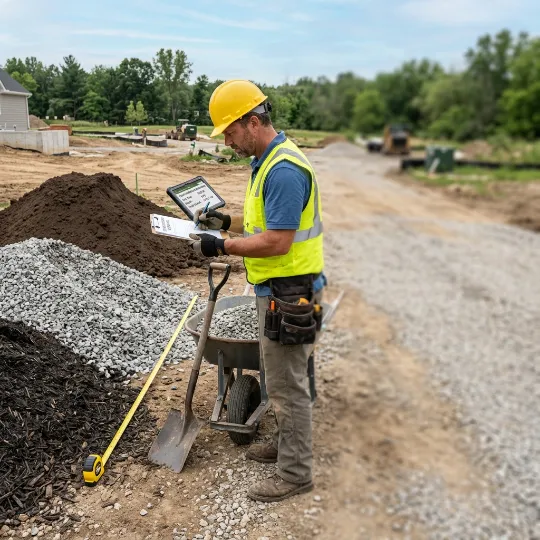
Why Cubic Yard Calculations Matter
Accurate volumetric calculation is the foundation of every cost-effective landscaping, hardscaping, and earthwork project. Bulk raw materials—such as premium screened topsoil, decorative bark mulch, crushed stone aggregate, washed concrete sand, and ready-mix concrete—are priced and delivered by the cubic yard (27 cubic feet).
Underestimating yardage leaves project work stalled, forcing expensive secondary short-load freight fees or frustrating runs for expensive bagged products. Conversely, over-ordering results in wasted budget and massive piles of unusable material blocking driveways or access roads. Calculating square footage, exact inch depth, compaction settling, and tonnage requirements guarantees precise delivery tickets the first time.
How the cubic yard calculator works
Convert surface dimensions into accurate bulk cubic yardage in three simple steps.
1
Enter Area Dimensions
Input length and width in feet, diameter for circular flower beds, or directly enter known total square footage.
2
Set Depth & Waste
Specify desired thickness in inches alongside a 5% to 15% compaction and subgrade grading buffer.
3
Review Bulk Delivery
Get immediate totals for cubic yards, cubic feet, delivery weight in tons, and equivalent retail bagged units.
Standard Material Densities & Bulk Coverage Benchmarks
Industry volume-to-weight conversions and typical application depths across landscape and building materials.
| Material Type | Recommended Depth | Coverage per Cu Yd | Weight / Cu Yd |
|---|---|---|---|
| Shredded Bark / Wood Mulch | 2" – 3" | 108 – 162 sq ft | 800 – 1,000 lbs (0.4–0.5 tons) |
| Screened Topsoil / Garden Loam | 3" – 6" | 54 – 108 sq ft | 2,000 – 2,400 lbs (1.0–1.2 tons) |
| Crushed Stone Aggregate (#57 / 3/4") | 3" – 4" | 81 – 108 sq ft | 2,600 – 2,800 lbs (1.3–1.4 tons) |
| Coarse / Washed Concrete Sand | 1" – 2" | 162 – 324 sq ft | 2,600 – 2,700 lbs (1.3–1.35 tons) |
| Ready-Mix Concrete (Slab / Footing) | 4" – 6" | 54 – 81 sq ft | 4,000 lbs (2.0 tons) |
| Compost / Organic Soil Conditioner | 1" – 2" | 162 – 324 sq ft | 1,200 – 1,600 lbs (0.6–0.8 tons) |
How to use the cubic yard calculator
Using this cubic yard calculator simplifies material budgeting for gardens, driveways, retaining walls, and concrete slabs. Begin by selecting a Project Preset from the dropdown menu, or select "Custom Dimensions & Material" if you already have custom specifications. Next, select your Area Geometry: choose Rectangular / Square for standard lawns and slabs, Circular / Round Bed for curved plantings and tree rings, or Known Total Area if you have already mapped irregular garden beds in square feet.
Enter your measured Length and Width (or Diameter) in feet, followed by the planned Desired Depth in inches. Adjust the Compaction / Waste Factor percentage (typically 10% for loose soil and mulch to account for wheelbarrow spills and natural settling, or 12–15% for compacted stone aggregate sub-bases). Select your specific Bulk Material Type to generate accurate delivery weight estimates in both tons and pounds. Click Calculate Volume & Material to update your project summary.
Review the dark takeoff panel to view your exact bulk purchase volume in cubic yards and cubic feet, overall delivery hauling weight in tons, and the equivalent number of store-bought bagged units should you decide to pick up packaged material instead of booking a dump-truck delivery.
Formula Used in Cubic Yard Calculations
Cubic volume is calculated by multiplying total square foot area by the target depth converted to feet (inches ÷ 12), and dividing by 27 (since there are 27 cubic feet in one cubic yard):
Surface Area (sq ft)
(Length × Width in feet)
(Length × Width in feet)
×
Depth in Feet
(Inches ÷ 12)
(Inches ÷ 12)
÷
27 cu ft / yd
(Unit Conversion)
(Unit Conversion)
=
Base Cubic Yards
Order Volume = Base Cubic Yards × (1 + Waste Factor % ÷ 100). Delivery Weight (Tons) = Order Volume × Material Density Factor.
Trusted by Landscapers & Contractors
Helping landscapers, general contractors, and homeowners calculate exact bulk materials without waste or shortage.
"We poured a 24x30 concrete garage pad. The calculator gave us 8.9 yards with the 10% buffer, and our ready-mix truck delivered the perfect amount without paying for unused mud."
DB
Derek Bradley
"The delivery tonnage readout saved our driveway. Knowing that 6 yards of crushed stone weighs over 8 tons allowed us to have the dump truck drop it exactly where our bobcat could stage it."
SM
Sarah Mitchell
"Switching to circular geometry made our round garden focal beds trivial to calculate. Mulch coverage was spot on at 3 inches deep across 8 different rings."
CJ
Carlos Jenkins
"The bagged store equivalent feature is fantastic. Seeing that 2 yards equated to 27 bags showed us immediately that ordering a bulk dump trailer saved us over $140."
NL
Nathan Lawson
"Super clean interface on mobile while standing out in the yard with a tape measure. Instant recalculation when tweaking from 2 inches of compost to 4 inches."
RH
Rachel Hayes
"As a landscape maintenance foreman, I use this weekly for our seasonal mulch top-dressings. The metric cubic meter readout is also super helpful for our commercial reporting."
TK
Travis Keller

Frequently Asked Questions
There are exactly 27 cubic feet in one cubic yard. This is because a cubic yard measures 3 feet long by 3 feet wide by 3 feet high ($3 \times 3 \times 3 = 27\text{ cu ft}$). If you are purchasing bagged soil or mulch that is sold in 2 cubic foot bags, you need 13.5 bags to equal one bulk cubic yard.
Material weight varies significantly by moisture content and density. Shredded bark mulch is the lightest at 800 to 1,000 lbs (0.4 to 0.5 tons) per cubic yard. Screened topsoil weighs between 2,000 and 2,400 lbs (1.0 to 1.2 tons). Dense aggregates like crushed stone or washed sand weigh between 2,600 and 2,800 lbs (1.3 to 1.4 tons), while ready-mix concrete reaches approximately 4,000 lbs (2 tons) per cubic yard.
Ground surfaces are rarely perfectly level, leading to subtle subgrade dips that swallow extra material. Furthermore, granular aggregates and organic compost settle and compact significantly under rainfall or mechanical plate tampers (losing 10% to 15% of loose volume). Adding a 10% buffer prevents running short right before completing your project.
As a general rule, if your project requires more than 1 to 1.5 cubic yards (around 15 to 20 retail bags), bulk delivery from a local landscape supply yard is significantly cheaper per unit of volume, even after paying a standard delivery drop fee. Bagged materials are ideal for small top-ups under 1 yard or hard-to-access backyard beds where wheelbarrows cannot fit.
For annual mulch re-dressing, a 2 to 3-inch layer is ideal to suppress weeds and retain soil moisture without smothering plant root flares. For new raised garden beds or lawn turf establishment, apply 4 to 6 inches of screened topsoil or compost blend to provide sufficient root growth zone depth.
Related Hardscaping & Agronomy Tools
Optimize your field planning and land management projects.
Paver Patio Calculator
Estimate concrete paver counts, crushed stone base tonnage, bedding sand, and polymeric joint sand bags.
Tree Spacing Calculator
Calculate exact planting density per acre, row allocation, and seedling order buffers for orchards and windbreaks.
Sprayer Calibration Calculator
Calculate nozzle discharge in GPM and catch cup fluid ounces per minute for uniform chemical and liquid fertilizer coverage.
Need a Custom Calculator?
Don't see the specific forestry, landscaping, or earthwork tool you need? We can build it tailored to your exact project requirements.
Contact Us