
The Best Fluffy Pancakes recipe you will fall in love with. Full of tips and tricks to help you make the best pancakes.
Tree Spacing Calculator
Determine exact tree counts, planting density per acre, row allocation, and seedling nursery order requirements for fruit orchards, timber plantations, windbreaks, and agroforestry plots.
Planting & Spacing Inputs
Planting Takeoff Summary
Total Trees to Order
763
Trees
Includes 726 field trees + 37 replacement reserve trees (5%).
Planting Density (Trees Per Acre)
145
trees/acre
(358 / hectare)
Based on pure field area without perimeter headland deductions.
Area Per Tree
300
sq ft
~27.9 sq meters
Drip Line Tubing
10,890
Linear ft
Estimated row lateral run
Was this tool helpful to you?
Thank you for your feedback!
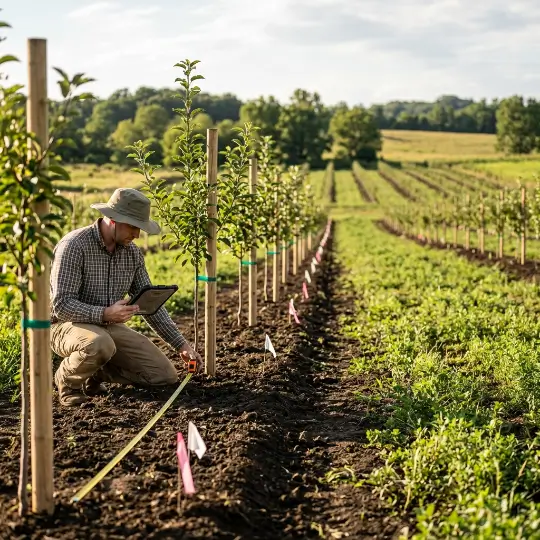
Why Tree Spacing Calculations Matter
Optimal tree spacing is the single most critical structural decision made when establishing an orchard, timber forest, or field windbreak. Planting too close invites excessive canopy shade, promotes fungal spore propagation, restricts machinery passage, and forces severe root competition for soil moisture and applied nutrients.
Conversely, excessive spacing leaves valuable productive acreage unutilized, increases inter-row weed management expenses, and postpones economic break-even timelines. Calculating Trees Per Acre, Row Spacing, and Replant Buffers prior to ordering nursery stock ensures maximum photosynthetic efficiency, streamlined tractor access, and optimal fruit or timber yield over the multi-decade lifespan of your stand.
How the tree spacing calculator works
Determine complete tree inventory and planting densities in three simple steps.
1
Select Species & Pattern
Choose an orchard or forestry preset or enter exact in-row and between-row distances with a square or triangular layout.
2
Set Area & Buffer
Define total planting acreage alongside a recommended 5% to 10% nursery loss reserve to guarantee 100% initial canopy fill.
3
Order Nursery Stock
Obtain instant figures for total trees to order, planting density per acre or hectare, and estimated drip irrigation tubing footage.
Standard Tree Spacing & Density Benchmarks
Horticultural and silvicultural standards for commercial fruit orchards, agroforestry, and timber plantations.
| Crop / Tree System | In-Row Spacing | Row Spacing | Trees Per Acre |
|---|---|---|---|
| Standard Semi-Dwarf Apple / Pear | 12' – 16' | 18' – 22' | 120 – 200 trees/acre |
| High-Density Dwarf Apple (Trellis) | 3' – 4' | 10' – 12' | 900 – 1,450 trees/acre |
| Peach, Nectarine & Plum | 14' – 18' | 18' – 20' | 120 – 170 trees/acre |
| Nut Trees (Pecan, Walnut, Chestnut) | 25' – 35' | 30' – 40' | 30 – 60 trees/acre |
| Citrus (Orange, Grapefruit, Lemon) | 12' – 15' | 20' – 24' | 120 – 180 trees/acre |
| Pine / Hardwood Timber Plantation | 6' – 8' | 10' – 12' | 450 – 725 trees/acre |
| Windbreak & Field Shelterbelt | 5' – 8' | 12' – 16' | 340 – 720 trees/acre |
How to use the tree spacing calculator
Using this tree spacing calculator streamlines commercial nursery purchasing, land preparation, and irrigation budgeting. Begin by selecting a Planting Preset from the dropdown or pick "Custom" to set unique parameters. Select your preferred planting grid geometry: choose Rectangular / Square Grid for traditional equipment traffic, or Triangular / Hexagonal Offset if you wish to maximize sunlight capture by staggering alternating trees.
Enter your planned In-Row Tree Spacing (the distance from trunk to trunk along a single row) and Between-Row Spacing (the width of the alleyway needed for tractors, sprayers, or mowers). Next, input your Total Planting Area in acres, along with a Replant / Loss Reserve percentage (typically 5% for bare-root stock or 10% for grafted specialty cultivars prone to early transplant stress). Click Calculate Tree Spacing & Order to refresh your project takeoff.
Inspect the dark summary panel to review your total tree nursery purchase count (including replacement buffer), planting density per acre and hectare, square feet allocated per mature canopy, and estimated linear feet of drip irrigation lateral line needed to water every row.
Formula Used in Tree Spacing Calculations
Tree planting density is determined by dividing total field square footage (43,560 sq ft per acre) by the ground footprint occupied per tree, adjusted for geometric layout patterns and seedling survival margins:
Total Field Area (sq ft)
(Acres × 43,560)
(Acres × 43,560)
÷
Space per Tree (sq ft)
(In-Row × Between-Row Spacing)
(In-Row × Between-Row Spacing)
=
Base Field Trees
Offset Triangular formula: Area ÷ (In-Row × Row × 0.866). Total Nursery Order = Base Field Trees × (1 + Replant Reserve % ÷ 100).
Trusted by Orchardists & Foresters
Helping commercial growers, orchard managers, and agroforesters calculate exact planting densities and nursery orders.
"We used this tool to lay out our 12-acre high-density Honeycrisp apple orchard on a 3x11 trellis. The nursery tree order with the 5% buffer was spot on."
GW
Garrett Wright
"The drip line footage calculation was a lifesaver. It made ordering rolls of emitter tubing for our olive grove straightforward without leaving excess scrap."
EM
Elena Morales
"Switching between rectangular and triangular offset gave us clear numbers on the 15% density bump for our pistachio acreage. Fast and cleanly designed."
BH
Brenton Hayes
"We planted 40 acres of loblolly pine for timber. The preset for 8x10 spacing matched our forestry consultant's exact stocking requirements."
KS
Kevin Strickland
"Terrific tool for designing property windbreaks. Being able to factor in a 10% seedling mortality cushion prevented empty gaps in our shelterbelt."
DN
Darren Nichols
"Instant real-time recalculation as you tweak tractor alley width. We avoided making rows too tight for our 75-hp cab tractor before breaking ground."
MA
Mateo Alvarez
Frequently Asked Questions
Between-row spacing is dictated by your largest anticipated orchard equipment (tractors, air-blast sprayers, mowers, and harvest wagons). Measure the widest implement width and add a minimum clearance margin of 3 to 4 feet on either side to prevent branch damage and fruit knocking when the tree canopy reaches mature spread.
Square or rectangular grid systems arrange trees directly across from each other in perpendicular lines, which simplifies cross-cultivation. Triangular (hexagonal) planting offsets alternating rows, creating equidistant hexagonal spacing that increases planting density by approximately 15.5% while optimizing sun exposure across neighboring canopies.
Commercial transplanting carries an inevitable 3% to 10% seedling mortality rate due to shock, bare-root desiccation, root rot, or rodent girdling during the first growing season. Ordering a 5% to 10% reserve ensures you have matching age and rootstock stock immediately available to fill dead spaces before adjacent trees shade them out.
Dwarfing rootstocks (like Geneva or Malling M9 for apples) restrict mature tree vigor to 25%–40% of standard size, allowing tight in-row spacing of 3 to 4 feet on support trellises. Semi-dwarfing rootstocks (M26, MM106) require 12 to 16 feet, whereas full-seedling standard rootstocks demand 20 to 25 feet to prevent severe canopy overcrowding.
For effective multi-row windbreaks, space fast-growing shrubs 4 to 6 feet apart, deciduous barrier trees 8 to 12 feet apart, and dense conifer evergreens (spruce, cedar, pine) 10 to 14 feet apart. Maintain 12 to 16 feet between adjacent rows to permit tractor weed mowing while establishing closed wind-deflecting barriers.
Related Hardscaping & Agronomy Tools
Optimize your field planning and land management projects.
Plant Population Calculator
Determine target row crop seeding rates, seeds per linear foot, and total commercial bag requirements per acre.
Sprayer Calibration Calculator
Calculate nozzle flow rates in GPM and catch cup fluid ounces per minute for uniform agricultural chemical coverage.
Paver Patio Calculator
Estimate concrete paver counts, crushed stone base tonnage, bedding sand, and polymeric joint sand bags.
Need a Custom Calculator?
Don't see the specific forestry, orchard, or landscaping tool you need? We can build it tailored to your exact requirements.
Contact Us