
The Best Fluffy Pancakes recipe you will fall in love with. Full of tips and tricks to help you make the best pancakes.
Black Walnut Tree Value Calculator
Estimate the standing timber and veneer stumpage market value of black walnut trees (Juglans nigra) based on trunk diameter (DBH), merchantable clear log height, Doyle board feet yield, and quality grades.
Tree Dimensions & Timber Grade
Walnut Timber Appraisal
Estimated Single Tree Value (Stumpage)
$
1,472
Market range: $1,250 – $1,690 depending on grain figure.
Merchantable Volume per Tree
184
Board Feet (BF)
(Doyle Scale)
Based on 22" DBH & 16 ft clear trunk height.
Total Stand Value
$
1,472
184 Total BF
Est. Green Log Weight
1,960
lbs
~0.98 tons log mass
Was this tool helpful to you?
Thank you for your feedback!
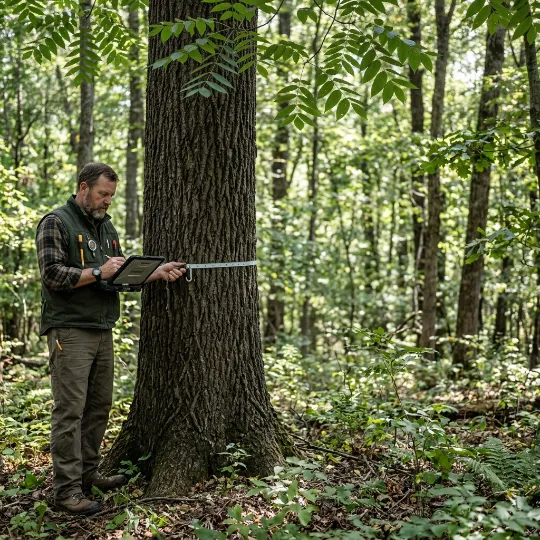
Why Black Walnut Tree Valuation Matters
Eastern Black Walnut (Juglans nigra) is the most valuable commercial hardwood tree species native to North America. Because of its prized chocolate-brown heartwood, dimensional stability, rich grain figure, and historical demand for luxury architectural millwork, gunstocks, and export flitch veneer, standing mature trees frequently command prices unmatched by any other timber species.
However, landowners routinely undersell or overestimate walnut trees without understanding how log buyers grade standing timber. A single 24-inch DBH walnut with 16 feet of clean, defect-free trunk can be worth several thousand dollars as prime sliced veneer, whereas a pasture or suburban yard tree of identical diameter with low forks and embedded wire may only yield pallet-grade lumber worth a fraction as much. Calculating board footage and market grade ensures equitable timber sales and protected forest assets.
How the black walnut tree value calculator works
Appraise standing walnut trees and woodlot timber assets in three easy steps.
1
Measure Trunk DBH
Measure trunk circumference at breast height (4.5 ft above ground) and divide by 3.14 to calculate DBH in inches.
2
Estimate Clear Height & Grade
Assess the defect-free trunk height below the first major limb and inspect the bark for knots, cat-faces, or wire.
3
Calculate Standing Stumpage
Instantly obtain Doyle board feet volume, individual standing tree worth, and entire woodlot timber asset totals.
Standard Black Walnut Log Grades, Board Foot Yields & Value Benchmarks
Industry timber grading standards, volume yields on the Doyle scale, and stumpage value expectations.
| Log Grade & Classification | Minimum DBH | Typical Stumpage Price | Required Characteristics |
|---|---|---|---|
| Prime / Export Sliced Veneer | 20" – 28"+ DBH | $7.00 – $14.00+ / BF | 4 completely clear faces, zero surface knots, cylindrical, 75%+ dark heartwood |
| Select Commercial Veneer | 18" – 24" DBH | $4.50 – $7.00 / BF | 3 clear faces, minimal sweep, light pin knots allowed on 4th side only |
| Grade 1 Sawlog (FAS Lumber) | 16" – 22" DBH | $2.50 – $4.00 / BF | Straight trunk, 2 to 3 clear cuttings, suitable for high-end furniture planks |
| Grade 2 Sawlog (Common Lumber) | 14" – 18" DBH | $1.25 – $2.25 / BF | Moderate surface knots, sound heart, slight trunk sweep under 2 inches |
| Grade 3 / Tie & Pallet Timber | 12" – 16" DBH | $0.60 – $1.10 / BF | Frequent limbs, spiral bark, crooks, lower heartwood-to-sapwood ratio |
| Yard / Landscape Walnut | Any DBH | $0.25 – $1.00 / BF | Short trunk (<8 ft clear), heavy branching, high risk of embedded metal or nails |
How to use the black walnut tree value calculator
Using this black walnut tree value calculator enables landowners, forestry consultants, and timber buyers to appraise commercial stumpage value before entering harvest contracts. Begin by selecting your timber's Wood Quality & Log Grade from the dropdown list. This preselects standard market pricing per board foot ranging from prime export sliced veneer down to residential yard timber.
Measure the trunk's Diameter at Breast Height (DBH) at exactly 4.5 feet (1.37 m) above the ground on the uphill side of the tree. If you measured circumference with a tailor's tape, divide that figure by 3.1416 to obtain diameter in inches. Select the Merchantable Clear Height representing the straight, branch-free section of the trunk from stump height up to the first major fork or limb cluster. Standard commercial logs are measured in 8-foot half-log and 16-foot full-log increments.
Review your log scaling rule (the Doyle Log Rule is universally utilized in hardwood timber transactions across the Midwest, Southern, and Appalachian forest regions). Adjust the Price per Board Foot to reflect current local sawmill bids or competitive consulting forester quotes. Click Calculate Black Walnut Value to review standing tree value, board feet yield, total stand valuation, and estimated green log weight.
Formula Used in Black Walnut Timber Valuation
Tree volume is computed using the industry-standard Doyle Log Rule (accounting for Girard Form Class 78 taper), followed by stumpage value multiplication:
(D − 4)²
(Top Scaling Diameter)
(Top Scaling Diameter)
×
Log Length (L)
(Clear Height in Feet)
(Clear Height in Feet)
÷
16
(Doyle Divisor)
(Doyle Divisor)
×
Price / BF ($)
Single Tree Standing Value = Doyle Board Feet × Price per Board Foot. Stand Value = Single Tree Value × Number of Similar Trees.
Trusted by Landowners, Foresters & Hardwood Mills
Helping private timberland owners and woodlot managers accurately appraise their high-value walnut trees.
"A logger offered me $800 for four giant walnuts on our creek bottom. I ran their DBH and 24-foot clear heights through this calculator and realized they were worth over $4,200 as veneer. It saved me from a huge mistake!"
RM
Richard Miller
Ohio Woodlot Owner
"As a consulting forester in Missouri, I use the Doyle scale daily. This tool is spot-on with Girard Form Class 78 taper deductions. It's the best quick reference I've found for educating clients on stumpage values."
DA
Derek Albright
Consulting Forester (ACF)
"We manage 120 acres of mixed hardwood timber in Indiana. Calculating stand totals with the board foot rate helped us determine which mature trees were ready for selective harvesting."
SK
Sarah Koenig
Timberland Investor
"The yard tree warning is so accurate. People think a 30-inch walnut in their front yard is worth ten grand, but with metal fence staples and low branching, it's risky for our bandsaw blades. Great educational tool!"
CP
Clint Parker
Custom Sawmill Operator
"We had two 26-inch black walnuts damaged by a wind storm. The estimated green log weight helped our local arborist arrange the right trailer crane to haul them off for commercial milling."
TE
Tom Evans
Rural Property Owner
"Comparing Doyle against International 1/4-inch gave me great insight into why sawmills scale small logs lower on Doyle. Essential knowledge for anyone selling timber in the Midwest."
BN
Bradley Nelson
Ag Extension Agent
Frequently Asked Questions
On average, a healthy mature forest-grown black walnut measuring 20 to 24 inches DBH with 16 to 24 feet of clean trunk is worth between $800 and $2,500 as standing sawtimber. Exceptionally large trees (26"+ DBH) with four clear faces and no internal defects can exceed $4,000 to $8,000+ as export prime sliced veneer. Conversely, smaller trees under 14 inches DBH have very little commercial value because of high sapwood percentage.
Yard trees develop in open sunlight, causing them to branch out low to the ground and producing very short merchantable clear trunks (often 6 to 8 feet or less). More critically, yard trees carry an extremely high risk of embedded tramp metal (fencing wire, nails, clothesline hooks, insulators, and eye bolts). Hitting embedded metal destroys costly commercial sawmill and veneer lathe blades ($1,000+ per strike), leading many log buyers to refuse residential yard trees altogether.
Veneer logs are the pinnacle of timber quality: they must be perfectly straight, cylindrical, at least 18" to 20" diameter inside bark, with four completely clear faces free of branch scars, seams, or pin knots. They are sliced into paper-thin sheets for high-end architectural panels. Sawlogs, by contrast, are sawn into dimensional 1-inch (4/4) or 2-inch (8/4) lumber and tolerate minor knots or slight sweep, commanding roughly one-third to one-half the price of veneer.
The Doyle Log Rule formula subtracts 4 inches from the scaling diameter for slab and sawdust kerf waste $((D - 4)^2 \times L / 16)$. On smaller logs (under 24 inches), this mathematical deduction heavily discounts volume compared to actual saw yields. Because Doyle has been the commercial hardwood standard for over a century, walnut buyers base their per-board-foot pricing on Doyle scale volumes.
Stumpage value is the net dollar amount paid directly to the landowner for the tree while it is still standing on the stump in the woods. Delivered mill price is what the sawmill pays at the log yard gate, which includes the significant costs of felling, skidding, bucking, loading, and trucking (typically 40% to 55% of the gross delivered value). This calculator evaluates standing stumpage value.
Related Forestry & Land Management Tools
Optimize timber planting density, bulk materials, and property improvement projects.
Tree Spacing Calculator
Calculate trees per acre, grid planting intervals, and total seedling count for orchards, windbreaks, and timber plantations.
Cubic Yard Calculator
Determine volume requirements in cubic yards, cubic feet, and tons for mulch, topsoil, gravel, and bulk materials.
Paver Patio Calculator
Estimate stone pavers, crushed aggregate sub-base tonnage, and bedding sand for outdoor hardscaping installations.
Need a Custom Forestry Calculator?
Looking for specialized timber cruise spreadsheets, log scaling rules, or plantation harvest modeling software? We build custom solutions.
Contact Us