
The Best Fluffy Pancakes recipe you will fall in love with. Full of tips and tricks to help you make the best pancakes.
Plant Population Calculator
Determine your target seeding rate, final plant stand, and total seeds required per acre. Calibrate planters accurately by calculating in-row seed spacing and linear foot population targets for maximum harvest yield.
Planter & Field Inputs
Population Summary
Target Seeding Rate
32,167
Seeds/Acre
Planned mechanical drop population based on row spacing.
Expected Final Plant Stand
30,559
Plants / Acre (95% Emergence)
Viable surviving plants estimated at harvest canopy closure.
Seeds Per Foot
1.85
/ linear ft
Planter calibration rate
Total Field Seeds
32,167
Required for 1 acre
Was this tool helpful to you?
Thank you for your feedback!
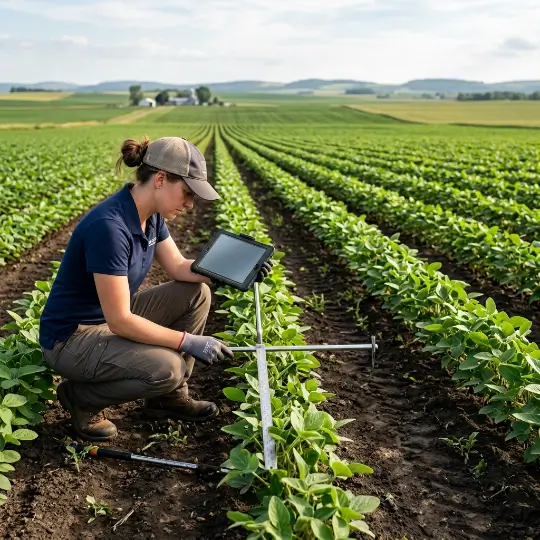
Why Calculating Plant Population Matters
Every seed dropped in the furrow represents an economic investment and a yield ceiling. Planting too thin results in unutilized sunlight, weed competition in open canopy gaps, and reduced bushels per acre. Planting too dense leads to barren stalks, lodged corn, inter-plant moisture stress, and wasted seed input costs.
By calculating Plant Population and Seeding Rates before rolling the planter, agronomists and growers can precisely calibrate meter drive sprockets, account for seed germination and soil emergence losses, and verify that row unit spacing will hit hybrid density sweet spots across every field zone.
How the plant population calculator works
Determine seeding targets, plant stands, and linear row calibration in three simple steps.
1
Set Spacing Geometry
Select your crop preset or enter your planter's exact row width and target in-row seed drop spacing.
2
Factor Emergence Rate
Account for certified seed tag germination and expected seedbed survival (typically 90% to 95%).
3
Calibrate Field Units
Instantly obtain target plants per acre, seeds per linear foot for trench scouting, and total bag requirements.
Benchmark Plant Populations for Major Field Crops
Standard target harvest stands and seeding rates across key commercial agricultural commodities.
| Crop Commodity | Standard Row Width | Target Plant Stand / Acre |
|---|---|---|
| Corn / Maize (Grain) | 30" (76 cm) | 30,000 – 36,000 plants/ac (higher for productive irrigated soils). |
| Soybeans (Drilled & Narrow Row) | 7.5" – 15" (19–38 cm) | 120,000 – 140,000 final stand (140,000–160,000 seeds planted). |
| Soybeans (Standard 30" Rows) | 30" (76 cm) | 130,000 – 150,000 final stand for full canopy closure. |
| Cotton (Upland) | 36" – 40" (91–102 cm) | 35,000 – 50,000 plants/ac (2.5 to 3.5 plants per row foot). |
| Grain Sorghum (Milo) | 30" (76 cm) | 60,000 – 90,000 plants/ac depending on regional moisture regime. |
How to use the plant population calculator
Using this calculator takes just moments before field planting or during early-season stand assessments. Start by picking your crop from the dropdown preset menu, which immediately fills in standard row widths and in-row seed spacings, or select Custom Row & Spacing Parameters to match your custom toolbar spacing.
Next, check your seed tag for the certified germination percentage and adjust the Emergence / Stand Rate to account for soil temperature and seedbed conditions (most growers use 90% to 95%). Enter your total planted acreage to instantly project bulk seed inventory needs.
Finally, click Calculate Plant Population. Review your live summary card showing target seeding rate, final emerged stand per acre, seed drop frequency per linear row foot for planter trench checks, and the total volume of seed required across your entire acreage.
Formula Used in Plant Population Calculations
Plant population is determined by the total square inches in one acre (43,560 sq ft × 144 sq in/sq ft = 6,272,640 sq in) divided by the surface area occupied by each seed furrow slot (Row Width in inches × In-Row Spacing in inches).
Total Sq Inches in Acre
(6,272,640)
(6,272,640)
÷
Seed Furrow Area
(Row Width × In-Row Spacing)
(Row Width × In-Row Spacing)
=
Target Population / Acre
Trusted by Commercial Farmers & Agronomists
Helping growers optimize seed placement and maximize field yields across North America.
"We dialed in our 24-row high-speed planter with this calculator. Knowing exactly how many seeds to expect per linear foot made furrow checks fast and foolproof."
DK
Darren Krause
"Switching between 15-inch and 30-inch soybeans used to require digging through manuals. This tool calculates our stand targets and seed counts in seconds."
BH
Brian Hensley
"The emergence percentage slider is critical. In heavy cold clay soils, our emergence drops to 90%, so adjusting our drop rate beforehand saved our yield potential."
WP
Wayne Peterson
"Super clean interface. We use the total seed requirement readout when ordering seed corn bags and pro-boxes for our variable rate prescriptions."
CM
Claire McCauley
"As an independent crop scout, I keep this bookmarked on my phone. When doing 1/1000th acre wheel checks, it gives instant validation on stand survival."
RL
Roger Lawson
"Straightforward math, zero clutter, and instantaneous recalculations. Easily the best plant population estimator available online."
GS
Glenn Stewart
Frequently Asked Questions
Seeding rate represents the number of seed units actually dropped into the furrow by the planter meter. Plant population (or final stand) is the actual number of healthy, emerged seedlings that survive and establish. Because germination is rarely 100% and early-season seedlings face insects, crusting, and rot, target seeding rates are generally 5% to 10% higher than desired plant population.
The most common agronomic method is the 1/1,000th of an acre measurement. For standard 30-inch rows, measure a distance of 17 feet 5 inches (which equals 1/1,000th acre). Count all healthy emerged plants along that length and multiply by 1,000 to determine your estimated population per acre. Repeat across several spots in the field for an accurate average.
Every field has an environmental carrying capacity governed by moisture, sunlight, and soil fertility. In dryland environments or lighter sandy soils, overly dense plant populations increase competition for limited water, leading to smaller ears, barren corn stalks, and lodging. Agronomic university trials consistently demonstrate diminishing returns beyond hybrid-specific economic optimum populations.
Soybeans planted in narrow rows (7.5" to 15") achieve earlier canopy closure, improving weed suppression and sunlight interception compared to 30" rows. While narrow rows often yield 3 to 5 bushels more in northern climates, growers can frequently reduce overall seeding rates slightly because equidistant plant spacing allows soybeans to branch out more effectively.
Under optimal soil moisture and warm seedbed conditions (soil temps above 50°F / 10°C), emergence rates typically average 93% to 96%. For early planting dates into cool, wet, or no-till residue soils, plan for 85% to 90% emergence to ensure your final established stand meets target hybrid recommendations.
Related Agronomy Tools
Optimize your field applications and farm economics.
Fertilizer Blend Calculator
Calculate exact pounds and percentages of Nitrogen, Phosphorus, and Potassium in custom mixes.
Growing Degree Days Calculator
Track cumulative heat units (GDD) to predict crop growth stages and harvest timing.
Crop Profit Calculator
Project agricultural crop revenue, variable input costs, and net farm operating margins.
Need a Custom Calculator?
Don't see the specific agronomy or landscaping tool you need? We can build it tailored to your exact requirements.
Contact Us