
The Best Fluffy Pancakes recipe you will fall in love with. Full of tips and tricks to help you make the best pancakes.
French Drain Calculator
Calculate exactly how much gravel you need for your French drain trench, accounting for the displacement of the perforated pipe.
Trench Dimensions
Material Required
Required Gravel Volume
0
cubic yards
Pipe displacement has been subtracted.
Total Excavation Volume
0
cubic yards of dirt
Filter Fabric Length
0
feet
Was this tool helpful to you?
Thank you for your feedback!
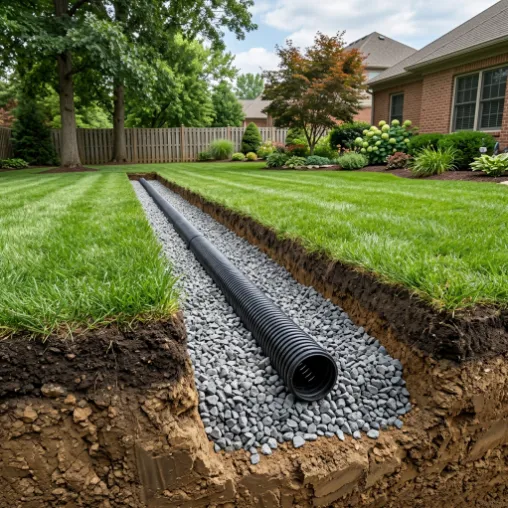
Why Calculate Gravel Volume Accurately?
Getting the right amount of gravel (drain rock) is the most critical logistical step in installing a French drain. Ordering too little halts your project while the trench is open, and ordering too much leaves you with a heavy, expensive pile of rock in your yard.
Our calculator takes the guesswork out of the process. Crucially, it calculates the total volume of your trench and then subtracts the volume displaced by the perforated pipe. For long runs, a 4-inch or 6-inch pipe displaces a significant amount of space—meaning you need less gravel than a simple rectangular volume calculation would suggest.
How French Drains Work
A simple, effective system to redirect standing water.
1
Collect Water
Surface water and high groundwater find the path of least resistance, flowing into the gravel-filled trench you've dug.
2
Filter & Enter Pipe
The water seeps through the filter fabric (which blocks silt) and gravel, entering the perforated pipe through holes in the bottom.
3
Divert Away
Gravity pulls the water down the slight slope of the pipe, safely directing it away from your foundation or soggy yard to a designated outlet.
Standard French Drain Materials List
What you'll need to complete your drainage project.
| Component | Purpose | Recommendation |
|---|---|---|
| Washed Gravel / River Rock | Allows water flow; structural support. | 3/4" to 1 1/2" size |
| Perforated Pipe | Carries water away quickly. | 4" Corrugated or PVC |
| Non-Woven Geotextile Fabric | Prevents soil from clogging the gravel. | 4 oz or heavier |
| Catch Basins (Optional) | Collects heavy surface runoff directly. | Place in low spots |
Formula Used for Calculation
We calculate the total trench volume in cubic feet, subtract the cylindrical volume of the pipe, and divide by 27 to get cubic yards.
Trench Vol (ft³)
−
Pipe Vol (ft³)
÷
27
=
Gravel Needed (Cu Yards)
Trusted by Homeowners & Landscapers
See how getting the math right saves time and money for drainage projects.
"This calculator was spot on! I was doing a 100-foot run to fix a soggy backyard. Factoring in the pipe displacement meant I didn't over-order gravel. Saved me about $80 in material and delivery fees."
MH
Michael Henderson
DIY Homeowner
"As a professional landscaper, I use this tool constantly. It’s simple, quick, and accounting for the pipe volume keeps my bids accurate. The interface is clean and works great on my phone in the field."
SR
Sarah Rodriguez
Landscape Contractor
"I didn't even realize I needed to subtract the space the pipe takes up until I found this site. My trench was deep (24 inches), so getting the math right was crucial before ordering the stone truck."
DP
David Patel
First-time DIYer
"Excellent resource. Not only did it help me calculate the washed gravel, but knowing the total excavation volume helped me figure out how many trips to the dump I'd need to make with the excess dirt."
JM
Jennifer Mitchell
Property Manager
"We put in a massive French drain system around our foundation to stop basement leaks. The 6-inch pipe displaced a lot of volume. This tool was a lifesaver for our material ordering process."
BK
Brian Kowalski
Homeowner
"Very handy. It would be nice to have an option to add a 10% waste/compaction buffer automatically, but otherwise, the core calculation is perfectly accurate. I recommend it to all my neighbors dealing with yard drainage."
AL
Amanda Lewis
Community Garden Admin

Frequently Asked Questions
For residential yard drainage, trenches are typically 18 to 24 inches deep. This allows for an adequate bed of gravel underneath the pipe, the pipe itself, and enough gravel and soil on top to conceal the drain and protect it from freezing if you live in a cold climate.
Yes! Skipping the landscape fabric is the number one cause of French drain failure. You must line the entire trench (bottom, sides, and fold over the top) with non-woven geotextile fabric. It acts as a filter, preventing soil and silt from washing into the gravel and clogging the system over time.
Washed, crushed stone or round river rock between 3/4 inch and 1 1/2 inches in size is ideal. The rock must be "washed" to remove fines and dust that could immediately clog the system. Avoid pea gravel, as it shifts easily and doesn't provide enough void space for fast water flow.
The holes on a perforated French drain pipe should face DOWN (around the 4 o'clock and 8 o'clock positions). Water fills the trench from the bottom up. Facing the holes downward allows water to enter the pipe sooner and helps prevent dirt from falling in through the top.
A French drain should slope at a minimum of 1% to ensure proper water flow. This translates to a drop of at least 1 inch for every 10 feet of length. You can measure this by driving stakes into the ground, running a string line with a line level, and measuring down to the trench bottom.
Related Landscaping Tools
Explore our other calculators for property management.
Need a Custom Calculator?
Don't see the specific environmental or landscaping management tool you need? We can build it tailored to your exact requirements.
Contact Us