
The Best Fluffy Pancakes recipe you will fall in love with. Full of tips and tricks to help you make the best pancakes.
Harvest Loss Calculator
Determine exactly how much grain is being left in the field behind your combine. Calculate your bushels lost per acre and the total financial impact to optimize your harvest settings.
Field & Count Data
Impact Analysis
Loss Per Acre
3.0
bu / ac
Total Farm Yield Lost
1,500
bushels
Financial Impact (Revenue Lost)
$
18,750
Was this tool helpful to you?
Thank you for your feedback!
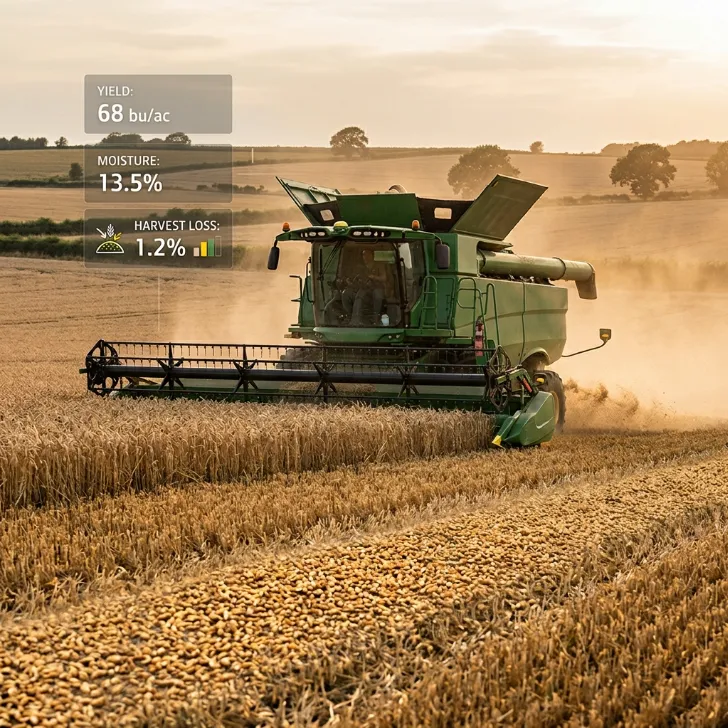
Why Measure Harvest Loss?
Every seed left on the ground is money left in the field. Even a seemingly small amount of grain blown out the back of the combine or missed by the header can add up to massive financial losses across hundreds of acres.
By dropping a 1-square-foot frame behind your combine and counting the seeds, you can determine if your loss is within an acceptable margin (usually 1% to 2% of total yield) or if you need to adjust your fan speed, rotor speed, or sieve settings immediately.
How Our Calculator Works
Determine your combine efficiency in three simple steps.
1
Drop the Frame
Toss a 1-square-foot frame (or a known area size) onto the ground behind the combine after it passes.
2
Count the Seeds
Count all the loose seeds or kernels within the boundaries of the frame. Enter that number in the tool above.
3
Analyze & Adjust
See your calculated bushel loss and financial hit. Use this data to justify tweaking your combine settings.
Rule of Thumb: Seeds Per Square Foot
Use this quick reference to understand how many seeds per square foot equate to 1 bushel per acre of loss.
| Crop Type | Seeds = 1 Bu/Ac Loss | Typical Acceptable Loss |
|---|---|---|
| Corn | 2 kernels / sq ft | ~ 1 to 2 bu/ac |
| Soybeans | 4 beans / sq ft | ~ 1 to 1.5 bu/ac |
| Wheat | 18-20 seeds / sq ft | ~ 1 to 2 bu/ac |
| Canola | 100 seeds / sq ft | ~ 0.5 to 1 bu/ac |
Formula Used for Calculation
We divide the seeds found per square foot by the crop's unique bushel factor to determine your exact loss.
(Seeds Counted
÷ Measurement Area)
÷ Measurement Area)
÷
Crop Factor
(e.g., 4 for soybeans)
(e.g., 4 for soybeans)
=
Bushels Lost Per Acre
Trusted by Farmers & Operators
See how this simple check saves operations thousands of dollars.
"We were rushing to beat the rain and I didn't realize how much we were throwing out the back. Counted 12 beans per square foot. Adjusted the fan and saved roughly $4k over the next 100 acres."
JD
John D.
Soybean Farmer
"Great quick reference tool. It puts a hard dollar amount on lazy combine settings. Makes it real easy to justify slowing down by 0.5 mph."
MP
Mark Peterson
Custom Harvester
"I pull this out every time we switch crop types or fields. The math is simple, but seeing the total farm impact reminds the crew why the 'drop pan' matters."
TR
Tom R.
Farm Manager
"Essential tool for calibrating machines across different fields. The interface is incredibly intuitive and quick to use in the cab while waiting on the grain cart."
SM
Sarah M.
Agronomist
"I thought our combine was dialed in perfectly, but the frame count told a different story. Saved us enough to pay for a new drop pan and then some."
DK
Dave K.
Corn Grower
"We run multiple machines and having all operators use this calculator ensures we are consistently minimizing loss across the entire fleet. Highly recommend."
PW
Pete W.
Harvest Crew Chief

Frequently Asked Questions
Zero loss is impossible. An acceptable loss is generally considered to be around 1% to 2% of your total yield. If you are yielding 200 bu/ac corn, 2 to 4 bushels of loss per acre is standard. Anything over that means you need to adjust your machinery.
Stop the combine and back up about 20 feet. Count the seeds on the ground *in front* of the combine (this is your pre-harvest shatter and header loss). Then count the seeds *behind* the combine. Subtract the front count from the back count to find out exactly what the separator/machine is throwing over.
Drop it in the direct discharge path behind the combine, where the chaff is spread. If your combine has a spreader, the loss might be spread out over the width of the header, which requires dividing your result by the header width ratio.
Yes. The rule of thumb (e.g., 4 beans = 1 bu/ac) assumes standard seed weights. If you have exceptionally large or small seeds due to drought or specific varieties, the exact bushel count might vary slightly, but it remains a highly accurate guide for field adjustments.
You should perform a drop pan test every time you change crop types, move to a new field with different conditions (like moisture level, slope, or yield potential), or adjust your ground speed significantly. As a general rule, a daily check in the morning and afternoon is a great standard practice.
Related Agriculture Tools
Enhance your farm management with these calculators.
Need a Custom Calculator?
Don't see the specific agronomy or machinery tool you need? We can build it tailored to your exact requirements.
Contact Us