
The Best Fluffy Pancakes recipe you will fall in love with. Full of tips and tricks to help you make the best pancakes.
Paver Patio Calculator
Accurately estimate total concrete or brick pavers, sub-base gravel tonnage, bedding sand cubic yards, and polymeric joint sand bags needed for durable hardscape patios, walkways, and outdoor living areas.
Patio & Material Inputs
Material Takeoff Summary
Total Pavers Needed
212
Pieces
Covers 192 sq ft patio area (includes 10% cutting waste).
Crushed Stone Sub-Base (#411 / Crusher Run)
4.3
Tons
(3.1 cu yds)
Includes 6" perimeter over-dig and 15% compaction allowance.
Bedding Sand
0.9
Tons
~0.7 cu yds (1" layer)
Polymeric Joint Sand
3
Bags
50-lb bags for joints
Was this tool helpful to you?
Thank you for your feedback!
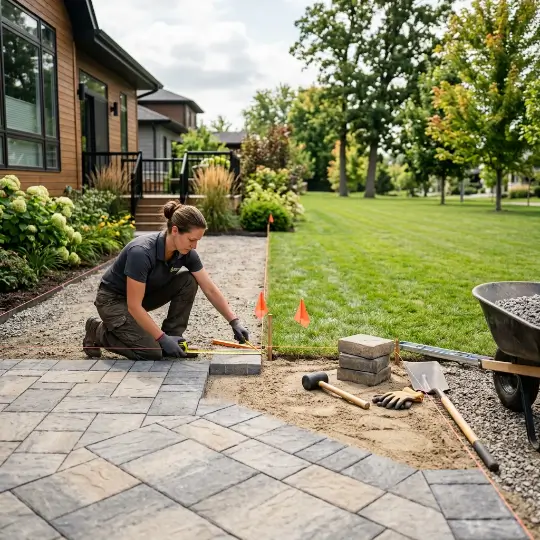
Why Paver Patio Calculations Matter
Accurate material estimation is the foundational cornerstone of any long-lasting patio or hardscape installation. Underestimating gravel or bedding sand forces costly job-site delivery delays and often tempts installers to compromise on critical sub-base depth, resulting in premature settling, shifting, and water pooling after severe winter freeze-thaw cycles.
By calculating Paver Units, Sub-base Aggregate Tonnage, and Bedding Sand Volumes before ordering materials, landscape contractors and DIY property owners can purchase bulk quantities at wholesale rates, account for essential cutting scrap along curved edges, and build structurally sound outdoor foundations that withstand heavy traffic for decades.
How the paver patio calculator works
Calculate your complete hardscape material takeoff in three simple steps.
1
Measure Space & Style
Select a project preset or enter your patio's planned length and width, choosing your favorite brick or slab paver dimension.
2
Configure Sub-Bases
Specify sub-base depth (4" for foot traffic or 8" for vehicular loads) alongside the 1" concrete bedding sand screed layer.
3
Order Precise Quantities
Get immediate totals for individual pavers, bulk gravel tons, sand volume, and polymeric joint sand bags ready for local quarry delivery.
Standard Paver Coverage & Recommended Base Depths
Industry engineering specifications for common interlocking concrete paver dimensions and load-bearing aggregate depths.
| Paver Format | Nominal Size (Inches) | Units per Sq. Ft. | Recommended Sub-Base |
|---|---|---|---|
| Standard Brick Holland | 4" × 8" | 4.50 pavers/sq ft | 4"–6" compacted crushed aggregate base |
| Square Cobble | 6" × 6" | 4.00 pavers/sq ft | 4" compacted gravel base for foot paths |
| Rectangle Accent Cobble | 6" × 9" | 2.67 pavers/sq ft | 4"–6" compacted gravel base with snap edging |
| Medium Square Tile | 12" × 12" | 1.00 paver/sq ft | 4" compacted crushed run + 1" coarse sand |
| Large Format Slab | 16" × 16" | 0.56 pavers/sq ft | 4"–6" gravel base, leveled with screed rails |
| Patio Stepper Slab | 18" × 18" | 0.44 pavers/sq ft | 6" base for frost-heave prone cold climates |
| Architectural Mega Slab | 24" × 24" | 0.25 pavers/sq ft | 6"–8" open-graded or dense aggregate base |
How to use the paver patio calculator
Using this calculator simplifies project budgeting and supplier quoting for any outdoor hardscaping work. Begin by selecting a Project Preset from the dropdown, or enter your planned Patio Length and Patio Width in feet. Choose your intended paver dimensions (such as standard 4" × 8" bricks or modern 12" × 12" slabs) and assign a cut and waste contingency (typically 10% for rectilinear grids or 15% for curved borders and herringbone patterns).
Confirm your sub-base depth (4 inches is standard for backyard foot traffic; 6 to 8 inches is recommended for driveway parking or freeze-thaw soil conditions) alongside the bedding sand layer (kept strictly at 1 inch uncompacted). Click Calculate Paver Materials to review your project breakdown.
Review the dark summary panel for your total required paver count, crushed stone sub-base tonnage, bedding sand volume, and polymeric joint sand bags. Share these exact tonnage figures directly with your local quarry or building materials supply yard to arrange flatbed or dump truck delivery.
Formula Used in Paver Patio Calculations
The standard civil hardscape formula calculates total surface area, accounts for cutting waste, and converts sub-surface excavation volumes to commercial delivery weights using aggregate densities (1.4 tons/yd³ for crushed gravel with 15% compaction, and 1.35 tons/yd³ for coarse sand):
Patio Area × (1 + Waste %)
(Length × Width × 1.10)
(Length × Width × 1.10)
÷
Single Paver Area
([L(in) × W(in)] ÷ 144)
([L(in) × W(in)] ÷ 144)
=
Total Paver Units Needed
Sub-base gravel formula: (Expanded Area sq ft × Depth in ft ÷ 27) × 1.4 tons/yd³ × 1.15 compaction factor.
Trusted by Landscape Contractors & Homeowners
Helping outdoor builders eliminate material shortages, prevent budget overruns, and build durable foundations.
"The gravel tonnage conversion with the compaction factor was spot on. We ordered 4.5 tons of crusher run for our 14x18 patio and had less than a wheelbarrow left over."
DC
Dave Callahan
"Having the polymeric joint sand bag estimate right on the summary card saved us an extra trip to the hardscape store in the middle of our weekend install."
MG
Marcus Gutierrez
"Accurate, super clean interface. We use this on our commercial landscaping bidding tablets to generate fast takeoff numbers while walking the property with clients."
SV
Sam Vance
"We selected the 15% waste factor for our 45-degree herringbone brick pattern. The calculator's paver estimate accounted for all of our edge cuts perfectly."
EW
Eric Wallace
"Great tool for DIY homeowners. It clearly outlines the sub-base depth and sand layer, which most online calculators overlook. Highly recommend."
RL
Rachel Lindqvist
"Instant recalculation as soon as you toggle sizes or depths. The side-by-side cubic yards and tons made calling in our aggregate order completely painless."
TL
Travis Lawson

Frequently Asked Questions
For standard pedestrian applications such as backyard patios and garden walkways, a minimum compacted sub-base depth of 4 inches of crushed stone (such as #411, Crusher Run, or 21A aggregate) is required. For areas subject to heavy freeze-thaw heaving or driveways carrying vehicular weight, install 6 to 8 inches of compacted base in 2-inch lifts.
The bedding sand layer (concrete coarse washed sand, ASTM C33) serves solely to seat the pavers evenly and allow them to interlock. If bedding sand is laid deeper than 1 to 1.25 inches, it will shift and settle unevenly beneath foot traffic and rain, creating depressions and ruining the level surface of the patio.
Standard masonry sand easily washes away in heavy rains, invites ant colonization, and allows weed seeds to germinate in joints. Polymeric sand contains chemical polymers that activate when misted with water, hardening into a flexible, durable binder that resists erosion and prevents weed growth while allowing micro-flexibility.
Installing an aggregate base that extends 6 inches beyond the perimeter pavers prevents "edge blowout" and provides a stable, solid anchor for edge restraints (plastic or aluminum edging spiked into the gravel). Without this perimeter over-dig, edge pavers will tilt and slide outward into surrounding soil over time.
For simple rectangular or square patios using straight running bond or stack bond patterns, a 10% waste factor is sufficient. For diagonal patterns, herringbone designs, circular patios, or layouts with curved meandering borders requiring extensive saw cutting, budget a 12% to 15% waste factor to avoid running short of full pieces.
Related Hardscaping & Agronomy Tools
Optimize your landscaping projects and outdoor builds.
Concrete Slab Calculator
Calculate cubic yards and premixed 60-lb and 80-lb concrete bags needed for footings, barn pads, and patios.
Plant Population Calculator
Determine target seeding rates, seeds per linear foot, and total bag requirements per acre.
Sprayer Calibration Calculator
Calculate nozzle flow rates in GPM and fluid ounces per minute for uniform agricultural chemical coverage.
Need a Custom Calculator?
Don't see the specific hardscape, agronomy, or landscaping tool you need? We can build it tailored to your exact requirements.
Contact Us