
The Best Fluffy Pancakes recipe you will fall in love with. Full of tips and tricks to help you make the best pancakes.
Soil pH Calculator
Determine the exact amount of agricultural lime or elemental sulfur needed to adjust your soil pH for optimal nutrient availability and crop yield.
Test Results & Goals
Amendment Plan
Total Needed
70
lbs
Product Type
Agricultural Lime
Target Action
Raise pH by 1.0
Was this tool helpful to you?
Thank you for your feedback!
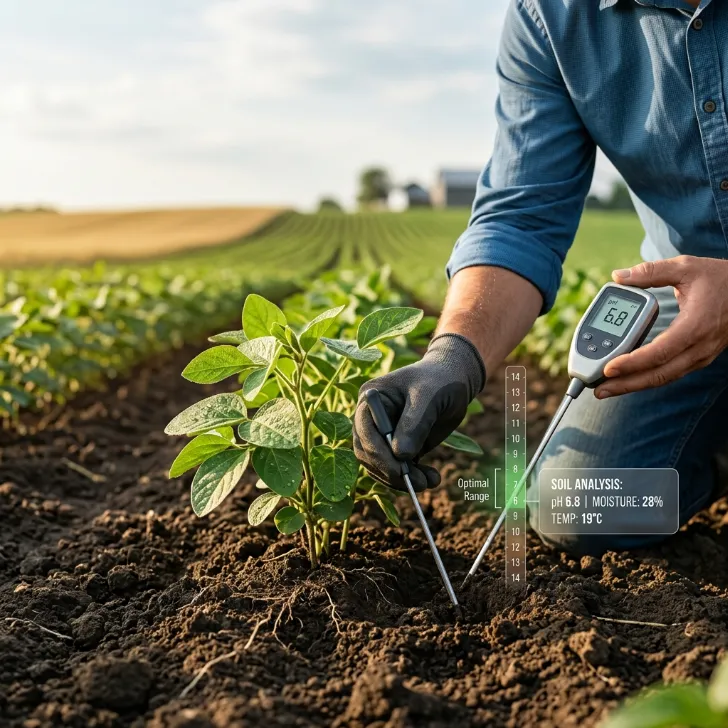
Why Adjust Your Soil pH?
Soil pH is the master key to nutrient availability. Even if you apply the perfect amount of fertilizer, plants cannot absorb vital nutrients like Nitrogen, Phosphorus, and Potassium if the soil is too acidic (low pH) or too alkaline (high pH).
For most crops, turf, and gardens, a pH between 6.0 and 7.0 is ideal. Adjusting your pH using lime (to raise it) or elemental sulfur (to lower it) ensures your fertilizer investment actually reaches the plant, unlocking higher yields and healthier growth.
How It Works
Fix your soil chemistry in three simple steps.
1
Test Your Soil
Take samples from various spots in your area and send them to a lab to get your precise baseline pH and soil type.
2
Set Your Goal
Input your current pH, target pH, and soil type. Heavy clay requires much more amendment than sandy soil to change pH.
3
Apply Product
We calculate exactly how much Lime or Sulfur you need to spread over your selected acreage or square footage.
Understanding Soil Buffering
Different soils resist pH changes differently. This table shows approximate amounts needed to shift pH by 1.0 unit per 1,000 sq ft.
| Soil Type | Lime to Raise pH (+1.0) | Sulfur to Lower pH (-1.0) |
|---|---|---|
| Sandy (Low Buffer) | 30 lbs | 10 lbs |
| Loamy (Medium Buffer) | 70 lbs | 15 lbs |
| Clay (High Buffer) | 100 lbs | 20 lbs |
*Note: These are standard agronomic estimates. Always refer to your specific lab test buffering index for absolute precision.
The Math Behind the Recommendation
Our tool uses established soil science buffering multipliers to estimate product needs based on your area.
pH Difference
(Target - Current)
(Target - Current)
×
Buffer Factor
(Based on Soil Type)
(Based on Soil Type)
×
Area Multiplier
(Sq Ft / 1000)
(Sq Ft / 1000)
=
Total Product Required
Trusted by Growers & Gardeners
Helping fix soil chemistry one acre at a time.
"My lawn was struggling because the pH was stuck at 5.2. This calculator told me exactly how many bags of lime I needed for my 8,000 sq ft yard. It's greening up perfectly now."
MD
Mark Davis
"I constantly under-applied lime because I didn't realize how much buffering my heavy clay soil has. This tool's soil type feature is a game changer for getting the math right."
JW
Jason Williams
"Needed to drop the pH for my new blueberry patch. Calculating elemental sulfur by square footage used to give me a headache, but this made it instant."
SA
Sarah Anderson
"I run a 200-acre corn operation and use this to spot-check VRT lime prescriptions against soil test zones. It's incredibly accurate and easy to use on my phone."
RB
Rick Baker
"Super straightforward. It tells me exactly what I need—whether it's lime or sulfur. Takes all the guesswork out of preparing my garden beds for spring planting."
LK
Luke Kelly
"I appreciate that I can switch between square feet and acres instantly. I use it for the home lawn and for our larger pasture fields without needing two different tools."
CM
Chris Miller

Frequently Asked Questions
Agricultural lime takes time to react with the soil. Depending on moisture, soil temperature, and how finely the lime is ground, it can take 3 to 6 months to see a significant change, and up to a year for the full effect. This is why many growers apply lime in the fall.
Clay soils and soils high in organic matter have a high "buffering capacity." This means they strongly resist changes to their pH chemistry. You must apply significantly more lime or sulfur to overcome this resistance compared to sandy soils, which change pH very quickly.
If your recommendation calls for more than 50 lbs of lime per 1,000 sq ft (or about 2 tons per acre) in an established turf or no-till situation, it is best to split the application. Apply half now and the other half in 6 months to prevent shocking the plants or creating a stratified layer at the surface.
Both will raise soil pH. Calcitic lime primarily adds calcium to the soil. Dolomitic lime contains both calcium and magnesium. You should choose dolomitic lime if your soil test also indicates a magnesium deficiency; otherwise, calcitic is typically preferred.
Elemental sulfur is generally safer and longer-lasting, though it takes a few months for soil bacteria to convert it into acid. Aluminum sulfate works almost instantly but can lead to aluminum toxicity in plants if over-applied. Our calculator provides recommendations based on Elemental Sulfur.
Related Agriculture Tools
Enhance your farm and garden management with these calculators.
Lime Requirement Calculator
Get highly specific liming recommendations based on buffer pH index lab test results.
Raised Garden Bed Calculator
Calculate exact cubic yards and bags of soil needed to fill your raised garden beds.
French Drain Calculator
Estimate the gravel, pipe, and fabric required to solve drainage issues in your field or yard.
Need a Custom Calculator?
Don't see the specific agronomy or machinery tool you need? We can build it tailored to your exact requirements.
Contact Us