
The Best Fluffy Pancakes recipe you will fall in love with. Full of tips and tricks to help you make the best pancakes.
Rainwater Harvesting Calculator
Instantly calculate the amount of rainwater you can collect from your roof to correctly size your cisterns, rain barrels, or storage tanks.
Catchment Details
Collection Results
Total Water Collected
888
Gallons
Adjusted for roof runoff efficiency.
Metric Volume
3,361
Liters
Storage Equivalent
16
x 55-Gal Barrels
Was this tool helpful to you?
Thank you for your feedback!
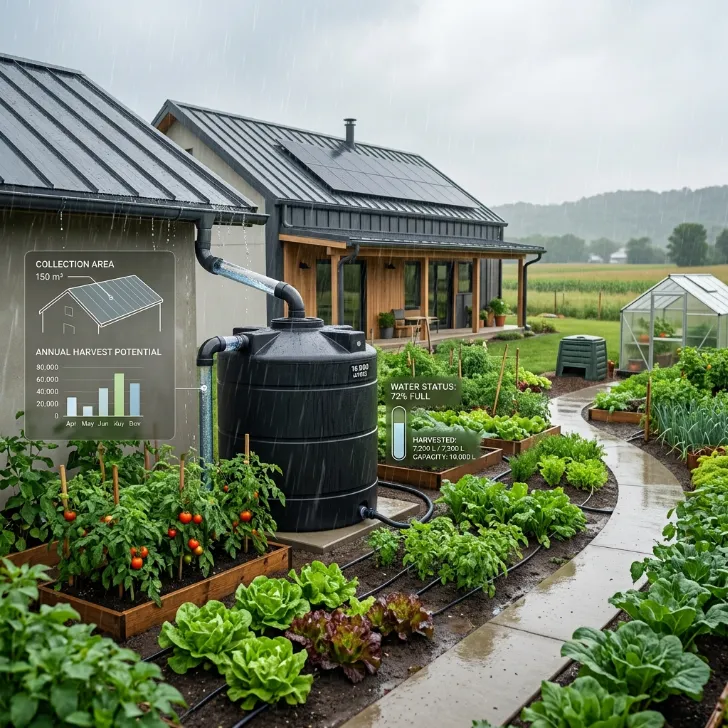
Why Calculate Your Rainwater Yield?
Avoid the most common mistake in rainwater harvesting: severely undersized tanks. Most homeowners and gardeners drastically underestimate how much water sheds off their roof during a simple rainstorm. A 1-inch rain event on a modestly sized roof can easily yield over 1,000 gallons of water.
By calculating your true collection potential based on your specific roof footprint and local average rainfall, you can correctly size your cisterns. This ensures you aren't wasting overflow during heavy rains while leaving your system dry when you need to irrigate gardens, flush toilets, or water livestock during dry spells.
How It Works
Calculate your rainwater collection potential in three simple steps.
1
Measure Roof Area
Calculate the length and width of the ground footprint your roof covers (including overhangs). Do not account for roof slope.
2
Check Rainfall
Enter the rainfall depth for a single heavy storm, a specific month, or your total annual average rainfall to see maximum capacity.
3
Size Your System
We multiply the area, rainfall, and material efficiency to tell you exactly how many gallons your system will generate.
Runoff Efficiency by Roof Material
Not all rain that hits your roof makes it to the gutter. Evaporation, absorption, and splashing cause minor losses depending on the material.
| Roof Material | Collection Efficiency | Characteristics |
|---|---|---|
| Metal (Corrugated / Standing Seam) | 95% | The gold standard for harvesting. Extremely smooth, sheds water instantly, and limits bacterial growth. |
| Asphalt Shingles | 90% | Common and effective, but porous grit absorbs minor amounts of light rain before runoff begins. |
| Concrete / Terra Cotta Tile | 85% | Highly porous materials. They must absorb water during the beginning of a storm before shedding runoff into gutters. |
The Math Behind Rainwater Yield
One inch of rain falling on one square foot of surface yields exactly 0.623 gallons of water. We multiply this constant by your area, rainfall, and material efficiency.
Area
(Sq Ft)
(Sq Ft)
×
Rain
(Inches)
(Inches)
×
0.623
(Constant)
(Constant)
×
Efficiency
(%)
(%)
=
Total Gallons
Trusted by Homeowners & Gardeners
Helping ensure accurate tank sizing for off-grid and supplementary water systems.
"I was going to buy a single 55-gallon rain barrel for my greenhouse. This calculator showed me that a simple 1-inch storm on my roof produces over 600 gallons. Upgraded to an IBC tote immediately!"
JS
John Smith
"Super straightforward. It perfectly calculates how much water I can expect annually. Helped me size the 2,500-gallon cistern for my off-grid cabin build in Colorado."
ED
Emily Davis
"I love how it accounts for roof material efficiency. I switched the setting from metal to asphalt shingle and could see exactly how much water I was losing to absorption."
MB
Michael Brown
"Great tool for sizing rainwater systems for raised garden beds. I was able to match my catchment potential directly to my summer watering requirements."
SJ
Sarah Johnson
"I use this tool for consulting on urban permaculture projects. Seeing the output in '55-gallon barrels' is a massive help for clients trying to visualize the sheer volume of water."
WT
William Taylor
"Accurate, fast, and works perfectly on my phone. Helped me figure out exactly how many square feet of barn roof I needed to gutter to fill up my livestock tanks."
JM
Jessica Martinez

Frequently Asked Questions
No. The pitch (steepness) of your roof does not affect the amount of rain that falls on it. You only need to measure the "footprint" of the building, plus the overhangs. Think of it as the area of ground that stays dry underneath the roof during a vertical rain.
A first flush diverter is a small mechanism installed on downspouts that captures the first few gallons of rain (which contains the most dust, pollen, and bird droppings) and diverts it away from your main tank. It significantly improves the water quality inside your cistern.
Untreated rainwater collected off a roof is strictly non-potable (not safe for human consumption). It is excellent for irrigation, flushing toilets, and washing. To make it safe to drink, it requires rigorous filtration (like reverse osmosis) and UV sterilization.
Yes, generally it is safe and highly beneficial for plants as rainwater is free of chlorine and municipal chemicals. However, it's advised to water the soil/roots directly (like with drip irrigation) rather than spraying overhead onto leafy greens to avoid potential bacterial splash from roof contaminants.
Every rainwater harvesting system must be designed with an overflow pipe that equals or exceeds the diameter of the inlet pipe. This safe-routes excess water away from your home's foundation during massive storm events when your tank reaches capacity.
Related Water Management Tools
Ensure your entire irrigation system is perfectly sized.
Water Storage Calculator
Calculate the total capacity of cylindrical tanks, cisterns, ponds, and reservoirs in gallons.
Sprinkler Coverage Calculator
Determine how much area overhead sprinklers or center pivots will cover in your fields.
Irrigation Pipe Size Calculator
Find the correct PVC or poly pipe diameter to reduce friction loss based on your flow rate.
Need a Custom Calculator?
Don't see the specific agronomy or landscaping tool you need? We can build it tailored to your exact requirements.
Contact Us