
The Best Fluffy Pancakes recipe you will fall in love with. Full of tips and tricks to help you make the best pancakes.
Drip Irrigation Calculator
Easily calculate your zone's total flow rate (GPM), number of emitters, and total water usage to ensure your pump and pipes are correctly sized.
System Details
System Results
Total System Flow
8.3
GPM
Ensure your water source provides at least this much.
Total Water Applied per Run
500
gallons
Total Emitters
500
emitters
Was this tool helpful to you?
Thank you for your feedback!
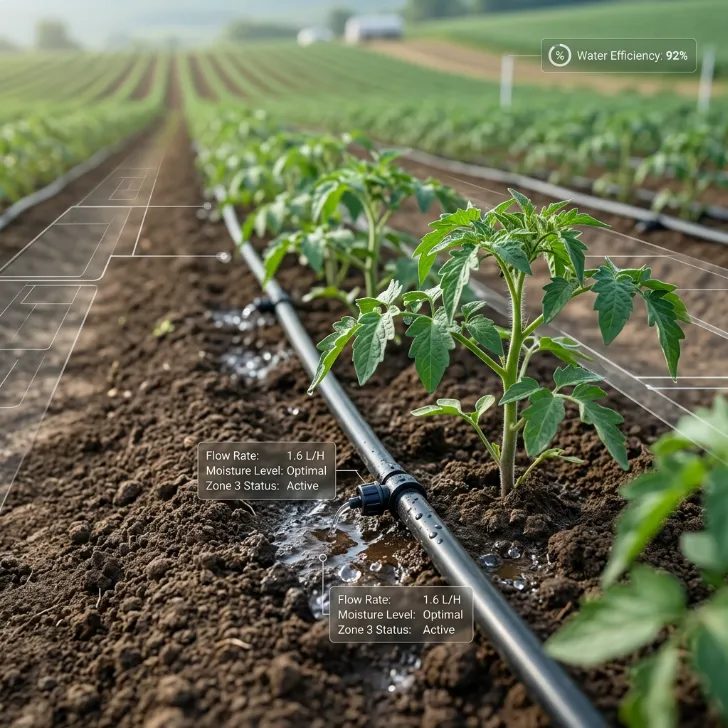
Why Calculate Drip Irrigation Flow?
Avoid the most common mistake in drip irrigation: exceeding your pump's capacity. Drip irrigation is highly efficient, but adding thousands of tiny emitters quickly adds up. If your total zone flow rate (Gallons Per Minute) exceeds what your well or municipal supply can push, the entire system loses pressure.
By knowing your exact emitter count and total GPM requirement, you can correctly divide your garden or farm into separate zones. Furthermore, calculating the total gallons applied over your run time ensures you are delivering exactly what your plants need to thrive without wasting water or washing out nutrients.
How It Works
Calculate your system requirements in three simple steps.
1
Measure Line Length
Determine the total feet of drip tape or tubing you plan to lay down within a single irrigation zone.
2
Check Emitter Specs
Check your drip tape packaging for the emitter spacing (e.g., 12 inches) and the flow rate per emitter (e.g., 1.0 GPH).
3
Calculate Totals
We compute the total emitters and aggregate the flow to tell you exactly how many Gallons Per Minute (GPM) your zone requires.
Common Drip Flow Rates by Soil Type
Matching your emitter flow rate to your soil type prevents runoff and ensures water permeates deep into the root zone.
| Soil Type | Ideal Emitter Rate | Characteristics |
|---|---|---|
| Clay Soil | 0.5 GPH | Absorbs water very slowly. Low flow prevents pooling and surface runoff. |
| Loam / Standard Soil | 0.9 - 1.0 GPH | The ideal balance. Moderate flow rate matches the soil's natural absorption rate. |
| Sandy Soil | 2.0+ GPH | Water drains rapidly. Higher flow rates ensure water spreads laterally before draining past roots. |
The Math Behind the Flow Rate
To find your total GPM, we calculate the number of emitters, multiply by the flow rate (GPH), and divide by 60 minutes.
Total Emitters
(Length / Spacing)
(Length / Spacing)
×
Emitter Rate
(GPH)
(GPH)
÷
60
(Mins/Hour)
(Mins/Hour)
=
Total GPM
Trusted by Growers & Landscapers
Helping ensure accurate irrigation planning for every project type.
"I was about to lay down 2,000 feet of drip tape on one zone. This calculator showed me it would require 16 GPM, but my well only does 10. Saved me from a massive failure!"
JS
John Smith
"Super straightforward. It perfectly calculates how many gallons I’m applying during a 45-minute cycle, which helps me precisely schedule my fertigation injections."
ED
Emily Davis
"Quickly switching between 8-inch and 12-inch spacing showed me exactly how much extra pump capacity I'd need. Makes designing irrigation grids so much faster."
MB
Michael Brown
"Great tool for sizing mainlines. Once I get the total GPM for a high tunnel using this calculator, I know exactly what size PVC pipe I need to run to that block."
SJ
Sarah Johnson
"I use this to figure out water volumes for my raised beds. Being able to see total gallons applied helps me ensure I'm not drowning my tomato roots."
WT
William Taylor
"Accurate, fast, and works right on my phone in the field. Essential tool for splitting a large garden into the right number of irrigation zones."
JM
Jessica Martinez
Frequently Asked Questions
Every water source (well pump, city spigot) has a maximum Gallons Per Minute (GPM) output. If your drip zone requires 15 GPM, but your source only provides 10 GPM, the system will lack pressure, and emitters at the end of your lines won't output any water.
Yes! Drip tape operates at low pressure (usually between 8 to 15 PSI). Most home water spigots and well pumps run at 40-60 PSI. Without a pressure regulator, the high pressure will easily blow apart your drip fittings or burst the tape.
Run time depends on your soil type and plant needs. Generally, it's better to water deeply and less frequently (e.g., 60-90 minutes, twice a week) than for 10 minutes every day. Deep watering encourages roots to grow further down, making plants more drought-resilient.
Drip tape is a thin, flat wall tubing with emitters pre-installed at set spacing, mostly used in straight vegetable rows for 1-2 seasons. Poly tubing is a thicker, round pipe often used in landscaping where you punch custom holes to insert button emitters exactly where you want them.
Clogging is usually caused by hard water minerals, algae, or sand in your water source. It is highly recommended to install a 150 or 200-mesh filter at the start of your system to catch debris before it reaches the tiny emitter holes.
Related Irrigation Tools
Ensure your entire water system is perfectly sized.
Sprinkler Coverage Calculator
Determine how much area overhead sprinklers or center pivots will cover in your fields.
Water Storage Calculator
Calculate the total capacity of cylindrical tanks, ponds, and reservoirs in gallons.
Irrigation Pipe Size Calculator
Find the correct PVC or poly pipe diameter to reduce friction loss based on your GPM.
Need a Custom Calculator?
Don't see the specific agronomy or landscaping tool you need? We can build it tailored to your exact requirements.
Contact Us